Knocking on Doors When Everyone Said the Internet Had Won: The Ground-Game Philosophy of the 2004 LaRouche Youth Movement
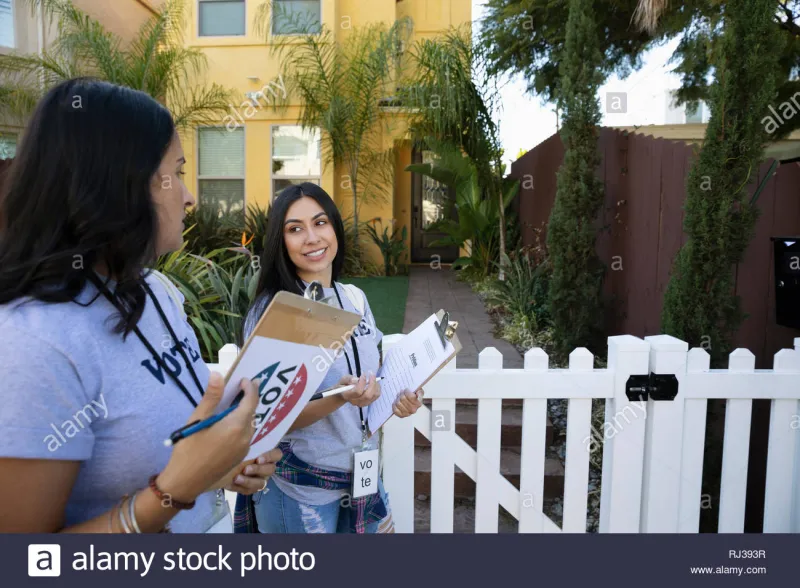
Photo: young political volunteers canvassing door to door neighborhood community organizing 2004, via c8.alamy.com
The year 2004 was supposed to mark the arrival of digital politics. Howard Dean's campaign had demonstrated that online fundraising could generate genuine political capital. Bloggers were reshaping how political information moved. Campaign consultants spoke with mounting confidence about email lists, website traffic, and the coming era of the networked political campaign.
In this environment, a group of young LaRouche campaign volunteers was doing something that looked, to outside observers, almost quaint. They were walking up to strangers' front doors, knocking, and having conversations about political economy.
Not thirty-second pitches. Not literature drops. Conversations — extended, substantive exchanges about the Federal Reserve, the physical economy, the structural failures of the Democratic Party's leadership, and the specific policy alternatives the LaRouche campaign was advancing. In an era increasingly dominated by the logic of digital optimization and message compression, the LaRouche Youth Movement operated on the premise that political persuasion could not be reduced to a click-through rate.
Two decades later, that premise looks less like nostalgia and more like prescience.
The Architecture of the Approach
To understand what made the 2004 LaRouche ground operation distinctive, it helps to contrast it with the prevailing models of political canvassing at the time. Mainstream campaigns in 2004 were increasingly moving toward what organizers called "voter contact" — scripted, time-limited interactions designed to identify supporters, persuade soft targets, and move on. The metric was doors per hour. The goal was data collection as much as persuasion.
The LaRouche Youth Movement operated from a fundamentally different theory of political change. Volunteers — most of them college-aged, recruited through campus organizing and drawn by the intellectual seriousness of the campaign's policy program — were trained not to deliver a message but to initiate an inquiry. The canvassing model was built around questions rather than statements: What do you think is happening to your community? How do you understand the relationship between the financial system and the jobs that have disappeared? What do you know about the history of American economic policy?
This approach had a practical justification rooted in the campaign's specific circumstances. LaRouche was not a candidate most voters had encountered through television advertising or major media coverage. His ideas were not pre-sold. The canvassing conversation was, in many cases, the primary point of introduction — which meant it had to be capable of doing real persuasive work rather than simply reinforcing a pre-existing impression.
"You couldn't rely on name recognition the way a major-party candidate could," recalled one campaign veteran who organized in the mid-Atlantic states during the primary season. "You had to actually make the case. That meant you had to know the material, and you had to be genuinely interested in what the person at the door was thinking. If you were just reciting talking points, they could tell immediately."
Training as Intellectual Formation
What separated the LaRouche Youth Movement's organizing model from conventional campaign volunteer operations was the depth of preparation it demanded. Before volunteers were sent into neighborhoods, they went through an orientation process that was closer to a political education seminar than a canvassing training session.
The curriculum drew on the campaign's policy documents — materials on the physical economy, the history of American banking legislation, the LaRouche analysis of the derivatives market, and the campaign's infrastructure proposals. Volunteers were expected to understand these materials well enough to discuss them without scripts, to answer follow-up questions, and to connect abstract economic arguments to the concrete circumstances of the communities they were visiting.
This investment in preparation had a secondary effect that campaign veterans describe as among the most significant outcomes of the entire organizing effort: it produced a cohort of young people who were genuinely, substantively educated in political economy. The canvassing training was, simultaneously, a formation process — one that shaped how participants thought about politics, economics, and civic life for years afterward.
"I came into the campaign knowing I was frustrated with the direction of the country," said one organizer who worked primarily in Ohio during the 2004 primary season. "I left it understanding why I was frustrated, in a way I could explain to other people. That's a different thing entirely. The door-knocking was how you tested whether you actually understood what you thought you understood."
Relationship-Building in an Atomized Landscape
The 2004 campaign's ground operation was also notable for its emphasis on sustained community presence rather than single-contact voter outreach. In neighborhoods where the campaign established organizing nodes — typically anchored by a local contact or a cluster of volunteers willing to return repeatedly — the model shifted from canvassing toward something closer to community organizing in the Alinsky tradition, though filtered through the campaign's distinctive intellectual framework.
Volunteers were encouraged to build relationships with residents across multiple visits, to attend community meetings and local events, and to position themselves as resources on policy questions rather than simply advocates for a candidate. This approach was labor-intensive and difficult to scale — it could not be replicated across an entire state the way a phone-banking operation could — but it produced a qualitatively different kind of political engagement.
In communities where the campaign maintained sustained presence, volunteers reported conversations of a depth and candor rarely achieved through conventional campaign contact. Residents who had been approached multiple times, who recognized volunteers as genuinely interested neighbors rather than electoral operatives, were willing to engage with difficult questions and to share perspectives that polling instruments could not capture.
Why the Analog Endures
The irony of the 2004 campaign's ground-game philosophy is that it has been validated most clearly by the failures of the digital model it was implicitly challenging. Twenty years of social media politics have produced, by most assessments, a more fragmented, more polarized, and less civically engaged electorate than the one that existed before the platforms arrived. The promise of digital organizing — that networked communication would produce networked political action — has collided repeatedly with the reality that online engagement and offline commitment are not the same thing.
Contemporary campaign strategists, including many who built their careers on digital optimization, have increasingly returned to the conclusion that face-to-face contact remains the most reliable method of genuine political persuasion. The research on this point has grown robust: door-to-door canvassing produces measurable changes in voter behavior that digital contact does not replicate. The mechanism is not mysterious. Human beings are social creatures who respond to the presence, attention, and sincerity of other human beings in ways that no algorithm has successfully simulated.
The 2004 LaRouche Youth Movement did not discover this principle. It is as old as democratic politics. But the campaign's commitment to it — maintained against the prevailing current of an era that was rapidly convincing itself otherwise — represents a practical contribution to the art of political organizing that deserves serious study.
The Living Archive
The young organizers who knocked on doors for the 2004 LaRouche campaign are, by now, in their thirties and forties. Many of them moved into careers in education, community development, policy advocacy, and civic life. They carry with them a set of organizing instincts — the priority of genuine dialogue, the importance of substantive preparation, the value of sustained community presence — that were formed in an unusual political school.
Their experience represents a living archive of the 2004 campaign's most distinctive contribution to American political practice: the demonstration that in an age of digital distraction, the most powerful organizing tool available is still a person willing to walk up to a door, knock, and take the conversation seriously.